Famous Paris Places and Neighborhoods
The Eiffel Tower
When the Eiffel Tower was completed in 1889, it was the tallest building in the world at just over 300 meters high. The tower was originally built as a temporary structure to commemorate the centennial of the French Revolution for the 1889 World’s Fair exposition. What was once a temporary exhibit became permanent and now the monument is the enduring symbol of the city of Paris and France itself.
Back in the 1880’s, the tower’s steel construction defied all traditional rules of architecture. Gustave Eiffel’s design was considered quite bold at the time. Today the tower is the main television transmitter for the city of Paris and the most visited site in France.
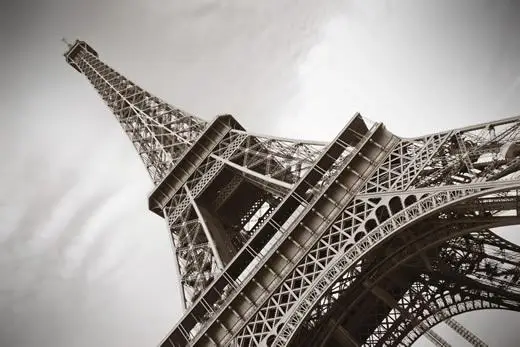
Read our full Eiffel Tower post.
Note: Is it recommended to book your Eiffel Tower tickets in advance.
The Arc De Triomphe
Shortly after his victory at Austerlitz in 1805, Napoleon commissioned the Arc de Triomphe’s construction; it was completed in 1836. There are four huge relief sculptures at the bases of the four pillars that make up the structure. These commemorate The Triumph of 1810 (Cortot); Resistance, and Peace (both by Etex); and The Departure of the Volunteers, more commonly known by the name La Marseillaise (Rude).
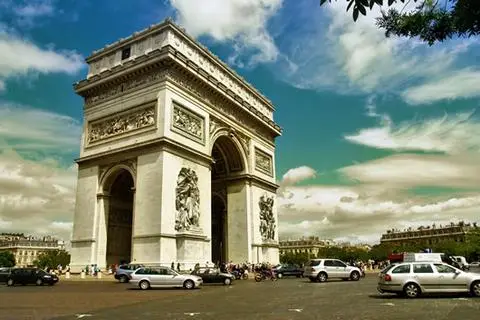
Beneath the Arch is the Tomb of the Unknown Soldier, and an eternal flame commemorating the dead of both world wars.
Every Armistice Day (November, 11) the President of France lays a wreath at the tomb. On 14 July – the French National Day (referred to as Bastille Day everywhere except in France) – a military parade down the Champs Elysees begins here. For important occasions of state, and national holidays, a huge French tricolor is unfurled and hung from the vaulted ceiling inside of the Arch.
Read our full post about the Arc de Triomphe.
The Champs-Élysées, the grand boulevard of Paris.
The river Seine divides this grand section of Paris, stretching from the imposing 18th century buildings of Les Invalides to the Art Nouveau Avenues surrounding the Eiffel Tower.
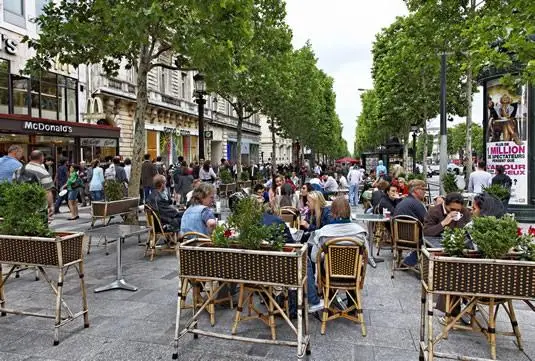
Two of Paris’s most impressive thoroughfares dominate the neighborhood to the north of the Seine: the ultra chic Champs-Élysées, and the rue du Faubourg Saint Honoré. St. Honoré is where you’ll find the well-guarded Palais de l’Élysée. It’s hard to believe this classy part of Paris was once a village (Chaillot), albeit a posh one, absorbed into the city in the 19th century. Not surprisingly, many of its opulent Second Empire mansions are now embassies or multi-national corporate headquarters.
The Champs-Élysées (Elysian Fields rendered in French) was designed to be a Royal promenade stretching from the Place de la Concorde to the Arc de Triomphe. Now filled with cars and mall-like shops, the new vision is to bring back the promenade feel, but without the royalty. Read more about it at Conde Nast Traveler.
Palais de Chaillot and Trocadero:
This immense Palais de Chaillot was built for the international exhibition of 1937 and is now home to four very different museums; with sections devoted to French monuments, the history of cinema, ethnology, anthropology and human biology, and to marine and naval history.
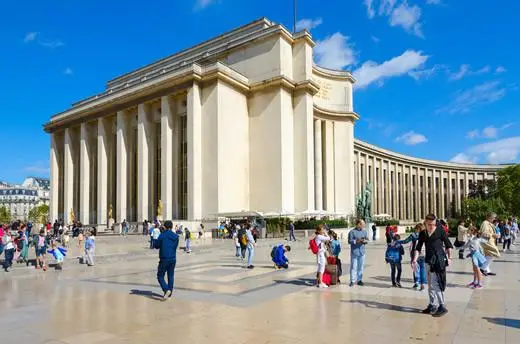
The complex also contains the Cinematheque repertory cinema and the huge Theatre National de Chaillot.
The fountains and statues in the Trocadero gardens below line up with the Eiffel Tower across the river and together form a gorgeous panorama when impressively lit up at night.
Champs-Élysées Neighborhood Ratings
| “Must See” |  |
| Area Hotel Quality: |  |
| Safety | |
| Convenience | |
| Overall Travel Experience and Recommendation | |
(“Five Towers” is the highest rating possible)
Contact us to create a perfect Paris vacation.
Saint-Germain-des-Prés
Get to know the charming Saint-Germain-des-Prés area of Paris
After World War II, Saint-Germain-des-Prés became synonymous with the intellectual life of Paris centered on the open bars and charming cafes. Philosophers, writers, actors and musicians mingled in the cellar nightspots and brasseries, where existentialist philosophy coexisted with American jazz.
The area is now wealthier than in the heyday of Jean-Paul Sartre and Simone de Beauvoir, or enigmatic singer Juliette Grécot and the new-wave film makers (such as Godard and Truffaut). However, the writers and wannabe poets are still around, enjoying the pleasures of sitting in Les Deux magots, Café de Flore and other haunts, or in the Jardins du Luxembourg, just behind the Odeon Theatre.
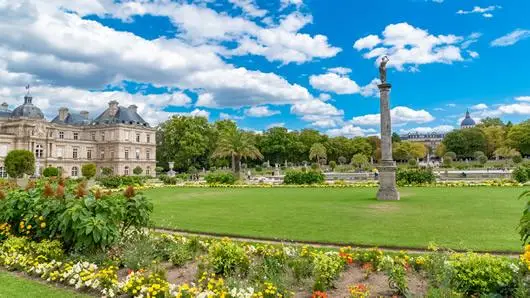
Most of the 17th century buildings have survived, but signs of change are evident in the number of affluent shops dealing in antiques, books and fashion. Somehow, Saint-Germain-des-Prés has become an up-to-date place, through which runs it’s namesake Boulevard Saint Germain.
The boulevard is the most celebrated of the entire left bank, and curves across three districts from The Ile Saint Louis to the Pont de la Concorde. The architecture in the area is quite homogeneous because the Boulevard was another of Baron Haussmann’s bold strokes of 19th century urban planning. A perfect destination to include on a private Paris walking tour.
Read more at our Saint-Germain-des-Prés post.
Jardins and Palais du Luxembourg
With its statuary, formal gravel paths and benches, the Luxembourg is the quintessential Paris park. Usual sights can include an apiary, joggers and martial art practitioners. Tennis courts, pétanque pitches, basketball courts, pony rides and puppet shows add to the fun. During summer weekends, the octagonal pond in front of the palace is surrounded by smartly dressed Parisian children bearing batons to guide the progress of their sailing boats.
The main entrance to the Luxembourg gardens is at the corner of bd St. Michel and rue de Medicis, 6th. Open daily, dawn until dusk.
Read our full Jardins and Palais du Luxembourg post for more information.
Tuileries and Opera
The 19th-century grandeur of Baron Haussmann’s Grands Boulevards offsets the bustle of bankers, theater-goers, sightseers and shoppers who frequent the area around the Opera. Throughout the neighborhood, a profusion of shops and department stores draw the crowds. Much of the area’s older character is found in the early 19th-century shopping arcades, with elaborate steel and glass roofs which are known as “galleries” or “passages” and were restored to their former glory in the 1970s. Gallery Vivienne, which is the choicest, has an elaborate, patterned mosaic floor. the Passage des Panoramas, Passage Verdeau and the tiny Passage des Princes are more old school Parisian.
The streets abound with food shops of all kinds, noted for their mouthwatering displays of expensive jams, spices, pates, mustards and sauces.
Elegant squares and formal gardens, among which the famous Tuileries park, give the area its special character. Parallel to the Jardin des Tuileries are two of Paris’s foremost shopping streets, the rue de Rivoli and rue St-Honore, full of expensive boutiques, bookshops and five-star hotels.
Monuments to monarchy and the arts coexist with modern luxury at its most ostentatious: the best example of this coexistence remains the Musee du Louvre, though other places, like place Vendome, home to exquisite jewelry shops and the luxurious Ritz Hotel, also are a heady mix of wealthy and chic.
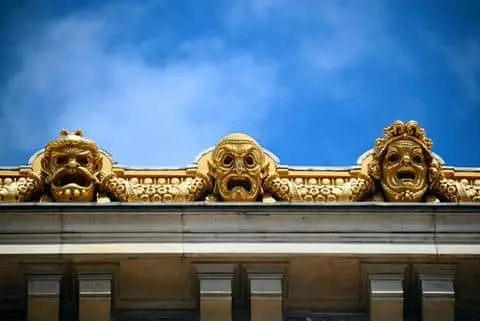
The Palais Garnier (Opéra): The palace, often referred to as “l’Opera”, with its sumptuous grand staircase, is a monument of the ostentatious wealth of the French Haute Bourgeoisie under the Second Empire (1851-1870). It was built by Charles Garnier, with added decoration from Chagall (1964), who painted a false ceiling.
Read our full Palais Garnier post.
The Tuileries Gardens
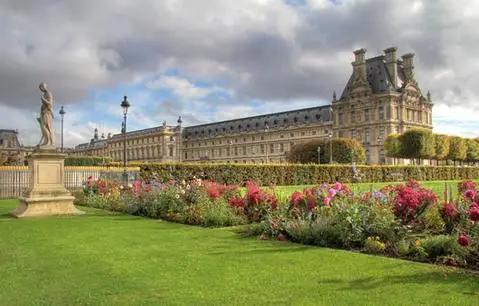
Between the Opera and the river Seine, bounded by the vast Place de la Concorde to the west and the Louvre to the east. The gardens replaced the Tuileries Palace, that burnt down during the 1871 Paris Commune unrest, leaving only the real tennis court, the Jeu de Paume, which is now used for contemporary art shows, and the Musée de l’Orangerie.
Read more at our Tuileries Gardens post.
Place de la Concorde
Between the Champs Elysees and the Tuileries Gardens, lies the historic Place de la Concorde. First planned as a grand setting for a statue of Louis XIV, the Place has had many names, and been the site of many grim moments in French history, most famously during the French revolution.
The size and grandeur of the Place made it the ideal setting for the guillotine where more than a thousand aristocrats and enemies of the Revolution were beheaded, among them, of course, Marie Antoinette and Louis XVI, and finishing with the once exalted, then disgraced, Robespierre.
After Napoleon I and III successfully righted the ship of state, the square was officially renamed Place de la Concorde in 1830.
At one end of the square is the magnificent Hotel Crillon; dead center is the priceless pink granite Obelisk of Luxor, presented to France in 1829 by the Egyptian Viceroy. The 3300 year old obelisk depicts the life and exploits of Ramses II in hieroglyphics.
Throughout the Place are statues representing the major cities of France: Brest and Rouen (in the northwest), Lille and Strasbourg (to the northeast), Lyon and Marseille (on the Quai des Tuileries) and Bordeaux and Nantes (in the southwest).
Tuileries and Opera Ratings
| “Must See” | |
| Area Hotel Quality: | |
| Safety | |
| Convenience | |
| Overall Travel Experience and Recommendation | |
The Historic Notre Dame de Paris Cathedral
Known as a gothic masterpiece, the cathedral of Notre Dame in Paris was conceived by Maurice de Sully in the 12th century. The cathedral took over 200 years to build. Construction was finally completed in 1345. In April of 2019, the cathedral was damaged in an inferno that ruined much of the structure. Rebuilding efforts are underway.
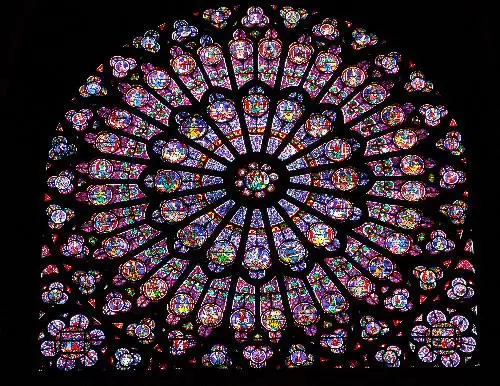
Notre Dame is the spiritual and geographical center of France. All road distances in France are calculated on the basis of the “0 km” marked on the square in front of the cathedral. It is also one of the most visited sites in France. For those so inclined, it is unlikely that a “hunchback” ever rang the bells, so don’t waste any precious vacation time looking.
Read our full Notre-Dame post.
Île de la Cité
Île de la Cité is considered the birthplace of Paris (read our complete Paris history). Notre Dame Cathedral, the Palais de Justice, and Sainte-Chapelle are all located on the Île de la Cité. Île de la Cité translates into “Island of the City” in English.
Along with the Sainte Chapelle, la Conciergerie was part of the original royal Palace in Paris on the Île de la Cité. The Gothic vaulted Salle des Gens d’Armes and massive kitchens remain from the medieval period.
The palace became a prison under the watch of the Concierge during the Reign of Terror during the French Revolution. Outside, la Conciergerie is the Tour de l’Horloge which contains the first public clock built in Paris. The clock, built in 1370, has been restored recently. It is a sight to see.
Link Paris Neighborhood Rating:
| “Must See” | |
| Area Hotel Quality: | |
| Safety | |
| Convenience | |
| Overall Travel Experience and Recommendation | |
(“Five Towers” is the highest rating possible)
At the eastern end of the island, a bridge connects with the smaller Île Saint-Louis. The island, a former swampy pasture, was transformed into a residential area with pretty, tree lined streets. Though Ile Saint Louis hosts no remarkable monuments, it’s considered one of the most pleasant places in Paris for a stroll or lunch. It has retained it’s charm and authenticity throughout the centuries.
- Sainte-Chapelle: 4, bd du Palais, 1st; phone : 43 54 30 09 – open Oct-Mar daily 10am-5pm; Apr-Sep daily 9.30am-6.30pm.
- La Conciergerie: 1, quai de l’Horloge, 1st; phone :
Musée d’Orsay
After the Louvre, the Musée d’Orsay is the most famous museum in Paris. It’s hard to believe that this light-filled building with a collection of amazing art was once a train station, but it was.
The original rail station was built by Victor Laloux and inaugurated in 1900 for that year’s Universal Exhibition. The first ever electric trains in France terminated at d’Orsay. The station was closed in 1939, a victim of progress as newer and bigger stations were built in Paris.
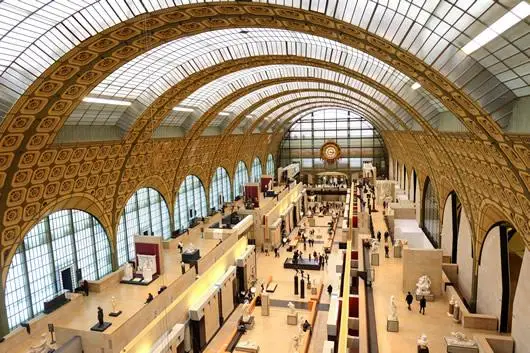
The structure was registered as a listed and protected building in 1978. The Musée d’Orsay opened on the site in December 1986. The museum was dedicated to housing works of art created during the period of 1848 through 1914. The vast collection containing paintings, pastels, sculptures, furniture and objets d’art, photography and documentary objects reflect the richness and diversity of this era.
The museum has a great restaurant and gift shop on site. Audio guides are available in many languages.
Visit our Musée d’Orsay page for more information.
Marais, Beaubourg, Les Halles, Bastille
Beaubourg and Les Halles are Paris’s most thriving public areas, with millions of tourists, shoppers and students flowing between them each year. Young people flock to Les Halles, shopping for the latest street fashions beneath the concrete and glass bubbles of the underground arcades.
All roads from Les Halles appear to lead to the Pompidou Centre, an avant-garde assembly of pipes, ducts and cables which houses the Musée National d’Art Moderne (Museum of Modern Art).
The smaller streets around the center are full of art galleries which make there home in crooked gabled buildings.
The neighboring Marais, with some of the oldest surviving streets and buildings in Paris, was abandoned by its royal residents during the 1789 Revolution, and it descended into an architectural wasteland before being rescued in the 1960’s.
It has since become a very fashionable address. Small cafés, bakeries and artisans still survive in its streets. Enchanting sites, like Place des Vosges, as well as the surrounding XVIIth-century buildings are must-sees, just like Place de la Bastille, with its brand new opera house.
Centre Pompidou
Opened in 1977, Centre Pompidou remains one of the most revolutionary contemporary buildings in Paris. Architects Richard Roger and Renzo Piano put the lifts, escalators, heating and air conditioning pipes on the outside, color coding them by their different functions and leaving the inside free for arts activities.
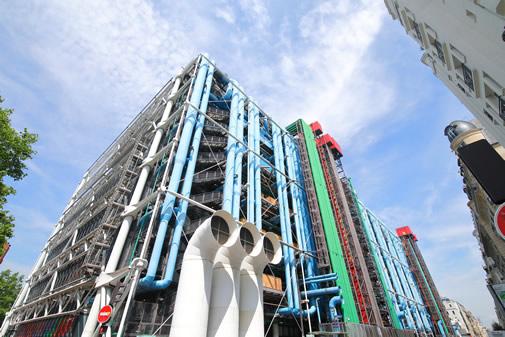
The policy of free entry, implemented by the governments Culture Department, means that the ground floor often resembles a rough and tumble speaker’s corner, a de facto extension of the street acts from the piazza outside. But do not let that put you off visiting the superb art collection, temporary exhibitions and the many other events.
Address: Plateau Beaubourg, 4th; phone : 44 78 12 33 – Open Mon, Wed-Fri noon-10pm; Sat, Sun 10am-10pm.
Place des Vosges
The square Louis XIII was planted in the midst of the elegant Place des Vosges.
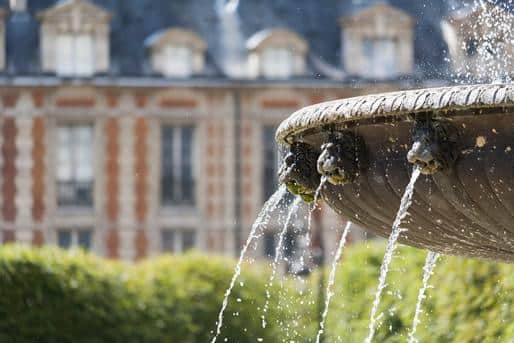
The Ginard fountain, whose waters are drawn from the Canal de l’Ourq, was inaugurated in 1811, and was replaced in 1835, when the four Ménager fountains were installed.
The arcades around house expensive antique shops, chic restaurants and the Maison de Victor Hugo.
Read our full Place des Vosges post for further information.
Bastille and the Opera:
Apart from a few chunks of the foundations inside the métro station, nothing remains of the infamous Bastille prison, which was stormed by the revolutionary masses in 1789.
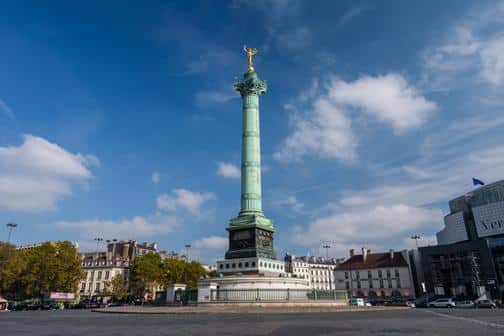
But the Place de la Bastille is still the scene of a lively street activity every Bastille day (on July 14th). The column in the center of Place de la Bastille commemorates the Parisians killed during the riots of 1830 and 1848, and is crowned by the gilded génie de la Bastille.
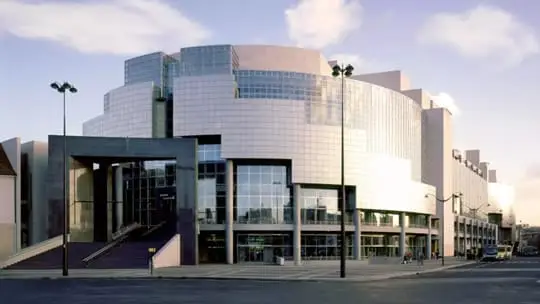
On the south side of the square, Carlo Ott built his granite and glass, 2700 seat Opera Bastille in 1989, commemorating the 1789 French Revolution.
Sacré-Cœur Cathedral
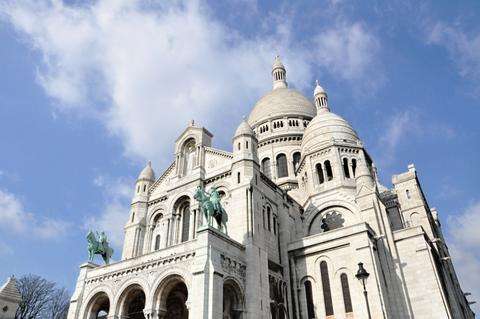
After the Franco-Prussian War ended in 1870, the people of France decided to construct a church in honor of the Sacred Heart in Paris on the butte Montmartre. Originally the funds for the construction of Sacré-Cœur basilica were to come only from wealthy donors. However in 1873, the government of France decreed its construction to be a state undertaking. Seventy-eight different architects entered a competition for the right to design the church. The winning design was submitted by a veteran architect named Paul Abadie. Abadie was already well known for his restoration of the St. Front Cathedral in Perigueux.
When Was the Sacré-Cœur Church Built?
The plans for the new basilica called for an edifice of Roman-Byzantine style, and the first stone was laid in 1875. Abadie died in 1884 with only the foundation of the church built. (Side Note: we offer a great private walking tour of Sacré-Cœur and the surrounding area)
Completed in 1914, the church, was not consecrated until 1919 after the end of World War I. The total cost to build the church was 40 million francs.
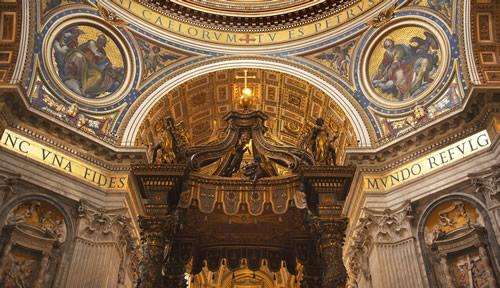
Sacré-Cœur is one of the best places in Paris to visit, rivaled only Montparnasse Tower and the Eiffel Tower, for a birds eye view of the city.
Visit our Sacré-Cœur page for more information.
The Latin Quarter in Paris
On the Rive Gauche (Left Bank) you’ll find the lively student area known as the Latin Quarter, so-named a few centuries ago because the students at the Sorbonne were speaking and learning Latin. Winding streets and few wide avenues make for a great walking area. Wandering will reveal cute shops and the remains of a Roman Amphitheater (Paris was once called Lutetia Parisiorum by the Romans. It’s a reference to the swamps beside the Seine. The look has improved over the centuries.
Besides students, the Latin Quarter is all about music. You go down into a cellar for the most part. Maybe that’s where we get the term dive bar? Mostly jazz but definitely pop-up raves as well.
The Latin Quarter area is home to many famous monuments, museums and gardens, ranging from the brand-new Institut du Monde Arabe to the Musee de Cluny, and the Museum National d’Histoire Naturelle (Museum of Natural History) in the Jardin des Plantes.
Pantheon:
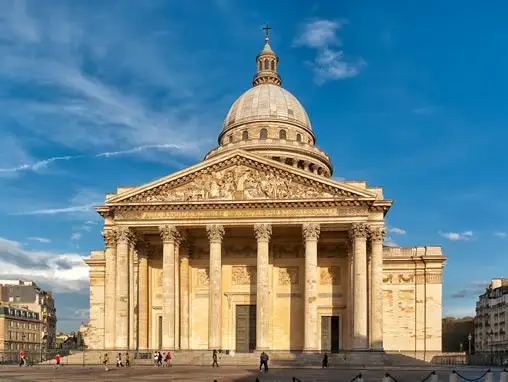
The domed landmark now known as the Pantheon was commissioned around 1750 as an abbey church. Due to financial problems the massive structure wasn’t completed until 1789. Two years later, the Constituent Assembly converted it into a secular mausoleum for the great men of the era of French liberty. Permanent guests of the Pantheon include Voltaire, Jean-Jacques Rousseau, Louis Braille, Emile Zola, Jean Moulin, René Cassin and Pierre et Marie Curie. The Pantheon’s ornate marble interior is less than cheerful, but you get a great view of the city from around the colonnaded dome, visible from all over Paris.
Address: Place du Panthéon, 5th arrondissement. Open year round from 10 am-6 pm.
Sorbonne:
Paris’s most famous university, the Sorbonne, was founded in the Latin Quarter in 1253 by Robert de Sorbon, confessor of Louis IX (Saint Louis), as a college for 16 poor theology students.
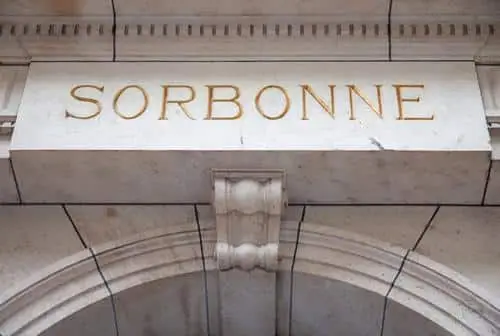
After centuries as France’s major theological center, it was closed in 1792 by the Revolutionary government but was reopened under Napoleon. Today, the Sorbonne’s main complex (bounded by Rue de la Sorbonne, Rue des Ecoles, Rue Saint Jacques and rue Cujas) and other buildings in the vicinity house several of the 13 autonomous universities created when the Université de Paris was reorganized following the violent student protests in 1968.
Place de la Sorbonne links Blvd Saint Michel with Chapelle de la Sorbonne, the University’s domed church, which was built between 1635 and 1642. It is closed except for special exhibitions. Visit the Sorbonne online for more information.
Musée de Cluny (musée du Moyen Age):
This crenelated building was the Paris home of the medieval abbots of Cluny. It was built on the ruins of a Gallo-Roman baths complex, which is now partly restored.
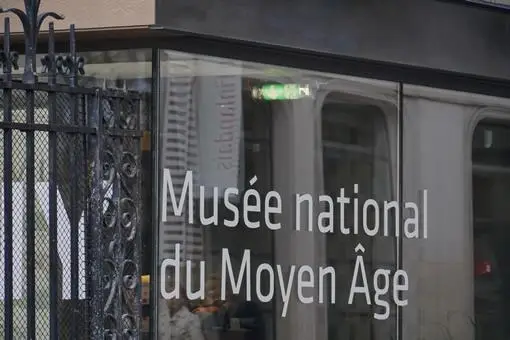
The museum houses an exceptional collection of artifacts, including the celebrated “Lady and the Unicorn” tapestries, medieval statuary, enamels, ivory, fabrics, illuminated manuscripts and precious metalwork.
Address: 6 place Paul Painlevé, 5th. Phone 43 25 62 00. Open Mon, Wed-Sun 9:15am – 5.45pm.
Museum National d’Histoire Naturelle (Museum of Natural History):
Within the Jardin des Plantes botanical garden, the reopened Grande Galerie de l’Evolution has taken Paris’s Natural History Museum out of the dinosaur age, with the latest lighting and audiovisual techniques. An extensive fossil and geology collection are housed in a separate building.
Address: 57 rue Cuvier, 5th. Phone : 40 79 30 00. open Mon, Wed, Fri-Sun 10am-6pm; Thur 10am-10pm.
Latin Quarter Paris Neighborhood Ratings
| “Must See” | |
| Area Hotel Quality: |  |
| Safety | |
| Convenience | |
| Overall Travel Experience and Recommendation | |
(“Five Towers” is the highest rating possible)
The Louvre Museum
Covering an area of some 40 hectares right in the heart of Paris, the museum offers almost 60,000 square meters of exhibition rooms dedicated to preserving items representing 11 millennia of civilization and culture, bridging the very old and the very new.
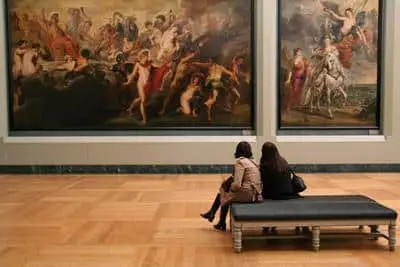
The museum is the biggest and most visited in the world, at close to 800,000 square feet and with 10 million visitors a year.
Read our dedicated Louvre museum post for more information.
Nearby, in the Tuileries – Orangerie Museum
Location: Jardin des Tuileries, Place de la Concorde
75001
| Address | Jardin des Tuileries, Place de la Concorde 75001 |
 | Concorde on the 1, 8, 12 lines |
Set in the southwest end of the Tuileries Gardens is the Orangerie Museum. The collection is made up of 144 paintings, predominantly by André Derain. There are also around 24 Renoirs, and about 24 of Soutines, fourteen Cezannes, a dozen by Picasso and Matisse, and some by Henri Rousseau, Utrillo, Modigliani, Marie Laurencin Van Dongen, Sisley, Soutine and Monet (Monet’s water lillies at the Orangerie).

The collection was given to France by Jean Walter and Paul Guillaume, on the stipulation that the works must always be exhibited together. It is very much a reflection of the fine and eclectic tastes of these two art mavens.
Don’t neglect to visit the basement Oval Rooms, where Monet’s Waterlily series is on permanent display.
This jewel of a museum doesn’t require marathon endurance to see it all and then return to your favorites for a second look.
La Defense
As the economy grew during the early 1960’s, the French government made the decision that instead of further crowding the city center of Paris they would create a business district outside the city. With tall buildings, colossal modern art, and concrete plazas, La Defense was regarded for a long time as a laboratory of contemporary architecture, with mixed results.
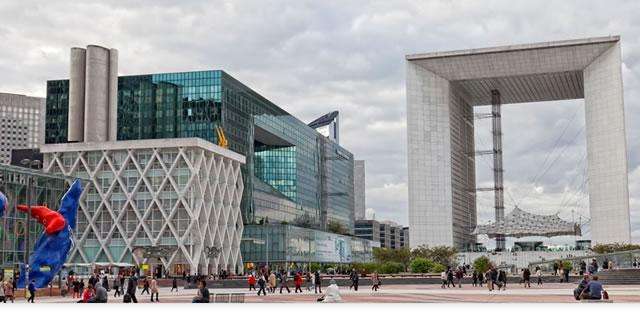
The district which extends along the communes from Puteaux, Courbevoie and Nanterre, is Paris’s business center and draws about 200,000 each work day.
La Defense is decorated by The Grande Arche. Finished in 1989 (one hundred years after the Eiffel Tower’s completion), the Arch is a modern salute to the Arc de Triomphe.
While the area offers good hotel deals at name brand hotels we recommend not staying in this area if you want to visit Paris on vacation. It’s a ghost town at night and quite far from all of the famous Paris sites. Is La Defense safe? Yes, it generally is a safe area, but it is still part of a large city so, as always, pay attention in large urban areas.
The area actually has a tourism site. Visit the La Defense website for more information.
La Defense Neighborhood Ratings
| “Must See” |  |
| Area Hotel Quality: | |
| Safety | |
| Convenience | |
| Overall Travel Experience and Recommendation | |
(“Five Towers” is the highest rating possible)
Historic Montparnasse
In the 18th century, students began reciting open air poems like the Greeks they admired. They named the hill where they gathered Mount Parnassus…. and voila, Montparnasse was born. This area has one of the grander boulevards of Paris, Boulevard Montparnasse, and also has the dubious honor of having Paris’s lone, reviled high rise, the Tour Montparnasse. The view of Paris from the observation deck is undeniably phenomenal, however.
Montparnasse was the favored neighborhood of artistic luminaries from Picasso to Hemingway, Chagall to Cocteau, until construction of the giant rail station meant blocks and blocks of cheap lodging was wiped away. Still, old school cafe life can be found at Le Dôme and La Coupole. Affordable crepe restaurants and stands are all over the area. This humble meal of Bretons took root since Montparnasse is where work-seekers from the region arrived in Paris in the 1930’s.
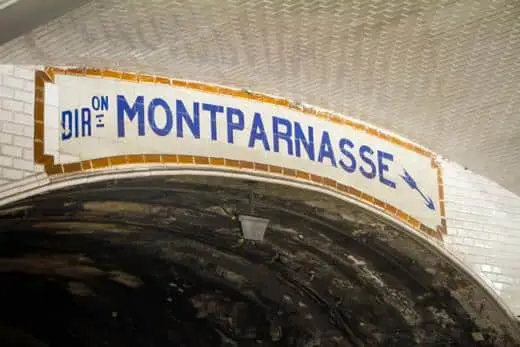
The area is neither fancy nor struggling, and is a haven for families that live and work in Paris. As such it’s a good destination for tourists looking for safe and decently-priced lodging.
About Montparnasse Tower:
It may be jarring to the eye amid the charm of Paris, but a visit to the tower is the only way to get those famous high shots of Paris without boarding a helicopter.
From the air-conditioned Montparnasse observation deck on the 56th floor, you can soak in the view, and then visit the restaurant and cocktail bar.
Open daily from 9:30 am to 10.30 pm in winter, 11.30 pm in summer.
| Address | rue de l’Arrivée, 75015 |
 | Gare Montparnasse (lines 4, 6, 12, 13) |
Montparnasse Neighborhood Ratings
| “Must See” | |
| Area Hotel Quality: | |
| Safety | |
| Convenience | |
| Overall Travel Experience and Recommendation | |
(“Five Towers” is the highest rating possible)
Take a private Montparnasse area walking tour with us.
Les Invalides
In 1670 King Louis XIV (the “Sun King”) founded a hospital for his old and injured “invalid” soldiers. Les Invalides was designed by architect Liberal Bruant. The hospital was completed in 1676. It was designed to house up to 4,000 soldiers. Today, Les Invalides is a museum and national monument, however, the French military still uses part of the complex as a base.
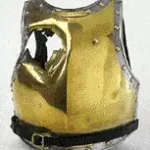
Beneath Les Invalides impressive gold dome are two churches. One for the common soldiers and the other for the King to be entombed upon his death. The King’s church is now the site of Napoleon’s tomb.
Visit our Les Invalides page for visitor hours and information.
The Bibliothèque Nationale de France
The National Library of France – The mission of the French national library, the Bibliothèque Nationale de France, is to collect and conserve all works published in France, regardless of media, with the explicit purpose of making them available to researchers and journalists. Under French law, all publishers must deposit several copies of each work they publish in the library upon publication.
In 1368, Charles V, “the Wise”, had his own personal library moved into the Louvre. The collection contained nine hundred and seventeen manuscripts. In those days, however, royal collections were transient in nature as they were irretrievably dispersed on their owner’s death. It was not until Louis XI, who reigned from 1461 to 1483, that continuity was established – reflecting the continuity of the royal dynasty. Charles VIII and Louis XII each added more manuscripts as well as the first printed books to the archive. The collection was never again to be dispersed.
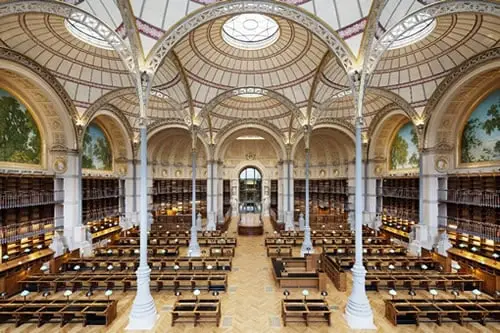
On the 28th of December 1537, the king introduced a new principle by royal decree, whereby all printers and booksellers were ordered to deposit copies of any printed book put on sale in the kingdom with the Château de Blois library. This obligation was known as the “Depot Légal” and its creation marks a fundamental date in the history of the library. Even though the decree was by no means uniformly enforced in the early stages, it marks an important date in French history.
The Bibliothèque Nationale de France was moved several times. First to Amboise and then to Blois and later to Fontainebleau. In the second half of the 16th century, the library was transferred to Paris. An inventory at the time listed just 4,712 manuscripts and printed works. In 1988, ground broke on a new site for the library in the 13th arrondissement of Paris. The much larger new building contains 3,600 reading units.
Significant Works
- About 12 millions books, among them two copies of Gutenberg Bible
- The world’s largest collection of geographical maps
- The richest collection of engravings (12 million) and photos (2 million).
- 250,000 manuscripts including the Dead Sea Papyrus and medieval psalm books.
- Painted works such as the Carolus Magnus and Louis IX’s private collections.
- Over 600,000 coins, medals and antiquities.
Visitor Hours for the Bibliothèque Nationale de France
Tuesday to Saturday: 10 a.m. to 7 p.m.
Sunday: noon to 6 p.m.
Quai Francois-Mauriac 75013
| Address | Quai Francois-Mauriac, 75013 |
| line 14, Grande Bibiliothèque, line 6, “Quai de la Gare” |
 | 62, 89. |
For more information about the Bibliothèque Nationale de France visit the library’s official website.
Heading to Paris? Contact us to plan an amazing vacation to Paris.
Hotel “Stayability” Index
(Five is the highest rating possible)
For more information and mass times, visit the Paris tourist office.
The Picasso Museum in Paris
History of the Picasso Museum – Pablo Picasso was a native of Spain, but he spent most of his adult life in Paris and along the Cote d’Azur. After his death in 1973, at the age of 92, the French government was given thousands of Picasso’s works in lieu of estate taxes. You can see a rotating collection of the 10,000 sketches, notebooks, fine art and ceramics Picasso produced at the 17th century mansion in the trendy Marais district that houses his work.
A multi-year expansion and renovation was completed in 2014, allowing many more works to be seen.
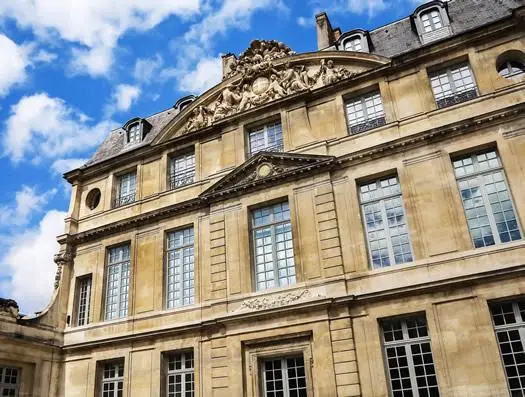
Works of Picasso’s contemporaries such as Cezanne and Matisse have been added to the museum’s collection over the years.
Visit our dedicated Musée Picasso page for more information.
Montmartre and Pigalle
Perched on a steep hill north of the city center is Montmartre and the beautiful Sacre-Coeur church. Montmartre remains a contained and slightly sullied throwback to a bygone era, with winding streets, ivy-clad houses with exquisite gardens, and artists’ studios that one could picture Picasso slaving away in.
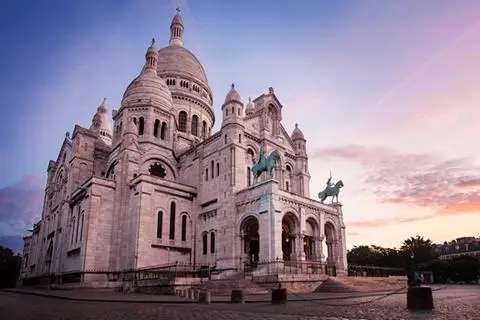
Sacre Coeur is endlessly besieged by bus tours, as is the Place du Tertre, the main artist hub adjacent to the church. As soon as you get off the main thoroughfares though, the area is surprisingly village like. The tiny 12th-century church of St-Pierre de Montmartre is one of the oldest in the city, while the quiet streets, cafes and squares have a character quite unlike the rest of Paris. It is a lovely neighborhood. It isn’t surprising that the area is one of the most popular tourist attractions if Paris.
For a total change of mood, head down to Pigalle, the neighborhood along Boulevards Clichy and Rochechouart. Once known as an area consisting primarily of neon-lit peep shows, Pigalle is increasingly the center for music, lively nightclubs and quirky late night bars, as more and more former cabarets reopen as modern clubs and bars.
The area can still be a little rough at night so be careful.
Montmartre and Neighborhood Ratings
(“Five Towers” is the highest rating possible)
The Bastille holds a special place of importance in French history. By crossing the Seine and following the Boulevard de la Bastille, you will find the site of the Bastille Saint-Antoine, which was a major part of the defenses ordered by Charles V in the dark ages. Original construction began back as far as the year 1370!
Louis XIV had the ramparts demolished but kept the structure as a “luxury” prison for people of “quality”. Seen by the commoners as a symbol of the arbitrariness of the old monarchy, the prison was stormed by local Parisians on 14th July 1789, and later razed. A column surmounted by the “Spirit of Liberty” on place de la Bastille was erected not to remember the surrender of the prison during the French revolution, but the July Revolution of 1830, which replaced the autocratic Charles X with the “Citizen King” Louis-Philippe.
The Bastille and The National Opera of Paris
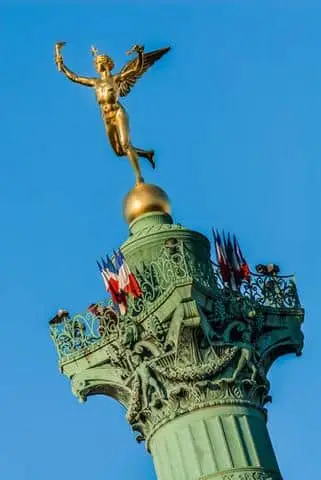
Months after the birth of the Second Republic in 1830, workers took to the streets demanding fairer treatment. All of eastern Paris was mobilized, with the fiercest fighting taking place on the rue du Faubourg-St-Antoine. The rebellion was quelled with a horrible massacre and deportation of the survivors, however it is the less contentious 1789 rebellion that France still celebrates. Political protesters have always used the area as a rallying point, and still do.
The Opera Bastille
The Opera Bastille was built by architect Carlos Ott and was inaugurated on July 14th, 1989. The modern building was designed to fit into the bustling working-class neighborhood where it resides. The main hall has a capacity of 2,745. There is also a 500-seat amphitheater and a 230-seat studio theatre on site.
The Neighborhood
The area was filled with lower-rent housing for a long time, but is now one of the most trendy areas of Paris. Businesses in the area range from old tool shops and ironmongers to cocktail haunts and sushi bars.
The Art
You’ll find art galleries clustered around rues Keller, Tamandiers and the adjoining stretch of rue de Charonne. And, on rue de Lappe, a very Parisian tradition: the “bals musettes”, or dance halls of the1930s “gai Paris”, frequented by Edith Piaf, Jean Gabin and Rita Hayworth.
Night life
The most famous bals musette,”The Balajo”, rue de Lappe was founded by Jo de France, who introduced glitz and spectacle into what were once seedy gangster dives, and brought Parisians from the other side of the city to savour the “rue de Lappe” life. The area can still be a rough place to be at night, so take care.
Visit the Opera Bastille website for more information.
Location: Place de la Bastille, 75012
Hotel “Stayability” Index
(Five is the highest rating possible)
We also offer Day Tours in Rome.